
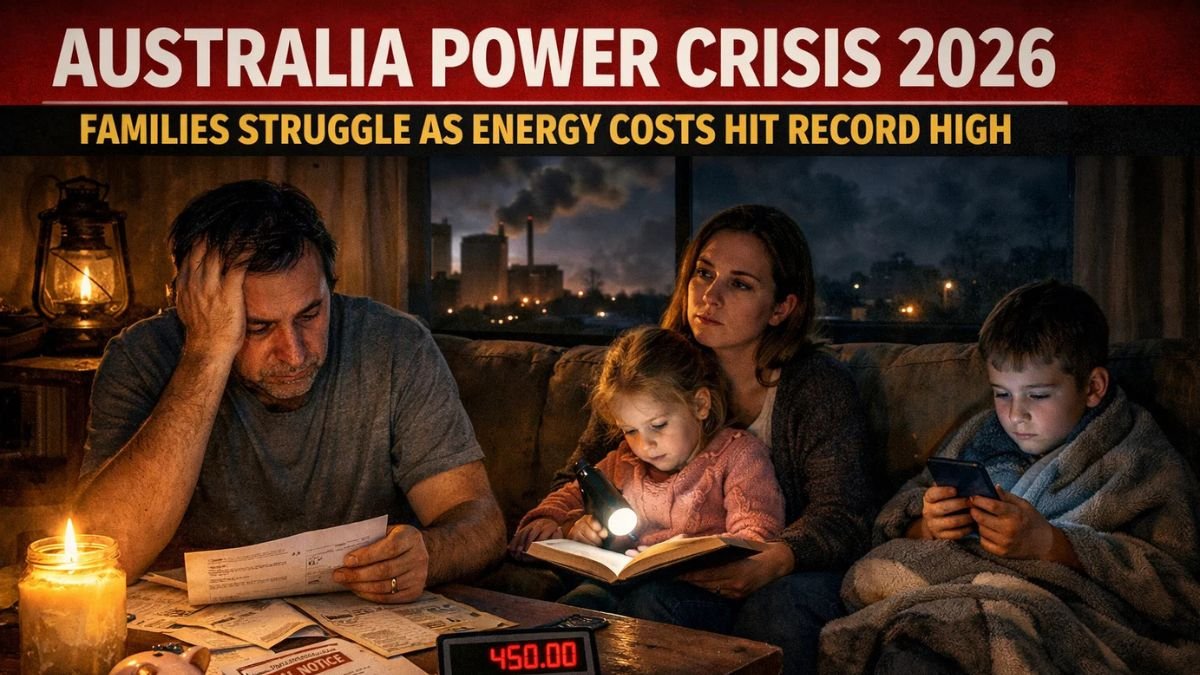
Australia Power Crisis 2026: Australia is currently witnessing a sharp surge in electricity prices, which is having a direct impact on ordinary households. In particular, electricity for domestic use has become significantly more expensive than ever before. This situation has been further exacerbated by the global energy crisis and domestic supply-related issues. Consequently, paying the monthly electricity bill is becoming a major challenge for many families. This is not merely an economic strain; it is also affecting people’s daily lives.
The Impact of Rising Electricity Rates on Households
The rise in electricity prices is disproportionately affecting middle- and low-income families. Many household budgets are being thrown into disarray due to this sudden increase in expenses. Families with limited or fixed incomes, in particular, are being forced to cut back on their essential needs. Prices tend to rise even further during peak seasons due to increased demand coupled with limited supply. In light of this, people are now actively seeking innovative ways to conserve energy in order to keep their expenses under control. It is evident that adopting energy-efficient alternatives has become more critical now than ever before.
Government Efforts and Initiatives
The Australian government is taking several measures to mitigate this problem. Energy rebate programs have been introduced to provide relief to low-income families, offering certain concessions on electricity bills. Furthermore, the government is increasing its investment in renewable energy projects with the aim of stabilizing energy prices in the future. However, experts believe that these measures are currently insufficient and that more robust strategies are required to provide long-term relief. To effectively tackle the energy crisis, the government must operate on a comprehensive and broad scale.
How to Cope with Rising Electricity Bills
Amidst rising electricity prices, Australian families are now adopting various strategies to reduce their expenses. These include switching off appliances that are running unnecessarily, utilizing energy-efficient lighting, and optimizing the usage of heating and cooling systems. Additionally, there is a rapidly growing trend toward the adoption of solar power. By installing solar panels, people can reduce their dependence on the grid and achieve significant long-term savings on their electricity bills. These small steps, taken collectively, can bring about major changes.
What the Future Holds
If the current situation persists, electricity prices could rise even further in the times to come. While government schemes and investments in renewable energy certainly offer hope, ordinary citizens must, for the time being, take proactive steps themselves. Energy conservation and the adoption of alternative sources may well prove to be the most effective solution to this problem. In the future, focusing on sustainable measures will be absolutely essential to ensure stable and affordable energy.
Key Government Schemes and Their Benefits
| Program Name | Eligibility | Benefits |
|---|---|---|
| Energy Rebate Program | Low-income households | Reduction in electricity bills |
| Solar Panel Subsidy | Homeowners | Up to 50% off installation |
| Renewable Energy Investment | National program | Increased green energy supply |
Conclusion
Rising electricity prices in Australia have emerged as a major economic challenge, impacting every segment of society. Although the government is making efforts at its level, ordinary citizens must also take steps toward conserving energy and adopting alternative sources. With proper planning and awareness, this problem can be tackled to a significant extent.
FAQs
Q. Why are electricity prices rising in Australia?
A. Electricity prices are increasing due to the global energy crisis, supply shortages, and higher demand during peak seasons.
Q. Who is most affected by rising energy costs?
A. Low-income households and families with fixed incomes are the most affected.
Q. What is the Energy Rebate Program?
A. It is a government initiative that helps reduce electricity bills for eligible low-income households.
